Exclusive 2026 access is here. Shop now!
Arabica
Madagascar’s Hidden Gem: The Return of Volcanic Arabica
At Kanto Coffee, we spend our days chasing flavor. Sometimes, that chase leads us to a familiar mountain in Colombia. Other times, it leads us to a story so incredible it reminds us why we fell in love with coffee in the first place. post description. Today, we’re taking you to an island off the coast of Southeast Africa. Not to Réunion, but close, just 500 miles west. We’re headed to Madagascar, and we’re bringing you a single-origin Arabica that almost disappeared from the earth.
2/12/20263 min read
The Prince of Réunion
To understand Madagascar’s coffee, you have to start on its neighboring island, Réunion. Back in the 1700s, when Réunion was still known as Île Bourbon, French traders brought Arabica plants to the volcanic Indian Ocean outpost. The plants struggled, but a select few adapted to the island’s rugged volcanic soil. They mutated. Their beans grew long and pointy, earning them the name Bourbon Pointu.
This was no ordinary bean. It became the preferred drink of King Louis XV, renowned for its delicate, fruity flavor and, uniquely for Arabica, naturally low caffeine. But this delicacy came at a cost. Bourbon Pointu is susceptible to disease and yields very little fruit. By the mid-1900s, commercial production had vanished.
However, the genetic line didn’t die. It traveled west to Madagascar.
A New Chapter in the Highlands
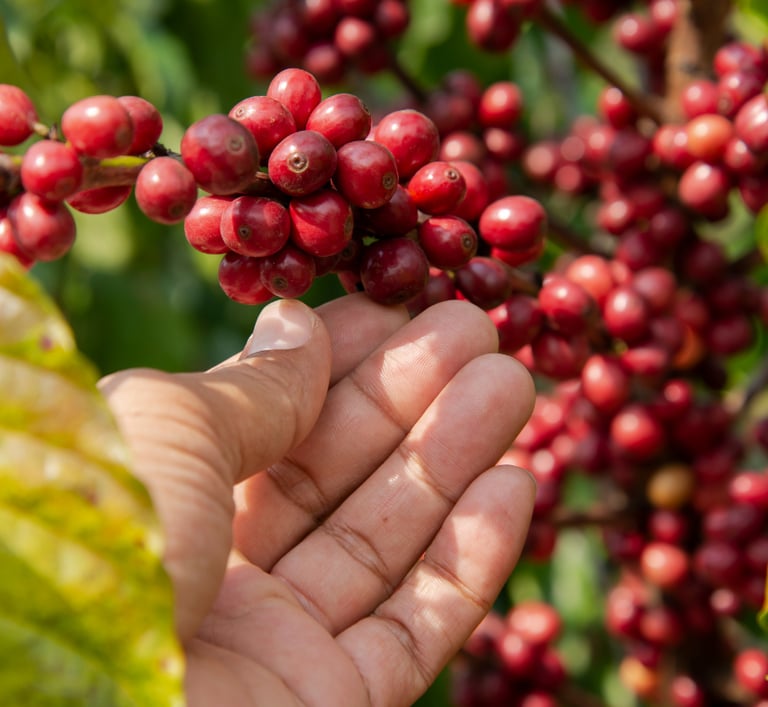
While Réunion’s coffee faded, the Bourbon variety took root in the rich volcanic soils of the Itasy region of Madagascar. Today, at elevations exceeding 1,200 meters, farmers here are cultivating the direct descendants of those historic French plants.
Unlike the mass-produced Robusta that makes up the vast majority of Madagascar’s crop, this Red Bourbon Arabica is rare, just 2% of the country’s output.
What does it taste like? Imagine this: Citrus brightness. Delicate floral tones. A sweet, lingering finish with hints of stone fruit. Grown in the cool, high-altitude microclimates around volcanic crater lakes, these beans offer a cup that is lively, complex, and utterly unique.
Coffee That Heals the Land
Here is the part of the story that matters most to us at Kanto.
Madagascar is a biodiversity hotspot. It is home to lemurs, chameleons, and forests found nowhere else on earth. But deforestation is devastating the island. Slash-and-burn agriculture, often for subsistence crops like rice, has destroyed vast swaths of forest.
Coffee is helping to reverse this.
Coffee is a shade crop. It needs trees to survive. Progressive farms in Madagascar are now implementing agroforestry systems, planting native canopy trees alongside lychee, banana, lemon, and mango. These trees do more than filter sunlight and protect the coffee plants from overheating. They restore the soil. They provide habitats for wildlife. They absorb carbon. And, if you ask us, they pass a little bit of that fruity sweetness directly into your cup.
Why We Brought This Coffee to Kanto
For decades, Madagascar disappeared from the specialty coffee map. Global prices crashed. The infrastructure collapsed. Farmers abandoned their plantations. But a new wave of producers is rebuilding the sector, not as it was, but better.
They are paying farmers fair, stable prices. They are offering training and high-quality seedlings. They are proving that you don’t have to cut down the forest to make a living; you can grow with it.
This is not just coffee. It is a reintroduction.
The Final Cup
When you brew this bean, you are tasting history. You are tasting the volcanic soil of Réunion, the highlands of Itasy, and the careful hand of farmers who refused to let their heritage go extinct.
Tasting Notes:
· Acidity: Citrus, Bright
· Body: Smooth, Balanced
· Flavors: Chocolate, Caramel, Stone Fruit, Floral undertones
Try it black first. Let it cool slightly. Stir it to introduce oxygen. Taste the sweetness before you add anything else. This is a coffee made for savoring, not rushing.
Shop the Madagascar Single-Origin Now.
From the volcanic slopes of the Indian Ocean to your morning mug, welcome back, Bourbon.
The most generous cup of coffee on the island. We are a Madagascar Coffee Roasting Company.
Condition
Newsletter
info@kantocoffee.shop
+261 379 930 417
2026 © Kanto Coffee Madagascar Ltd. All rights reserved.


Antananarivo, Madagascar




Kanto Coffee Madagascar Ltd
Contact